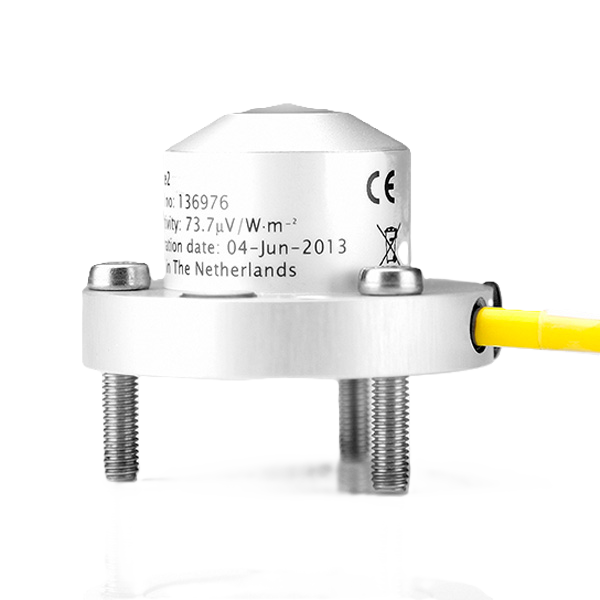
240-120 SP-Lite2 Silicon Pyranometer

$0.00
Choose Item:

Supplier: Novalynx Corporation

Fast-response solar radiation sensor for weather monitoring, agriculture, hydrology, and photovoltaic applications.

The 240-120 SP-Lite2 Silicon Pyranometer provides reliable measurement of global solar irradiance for routine environmental and solar-energy monitoring. Its silicon photodiode produces a voltage signal proportional to incoming radiation, allowing straightforward connection to compatible data loggers, indicators, and monitoring systems.

Compact, lightweight, and designed for outdoor operation, the SP-Lite2 is well suited for meteorological stations, hydrologic monitoring, agricultural research, evapotranspiration studies, building automation, and photovoltaic system performance monitoring.

Key benefits

  • Measures solar radiation from the entire hemisphere

  • Fast response for changing solar conditions

  • Compact and lightweight outdoor sensor

  • Integrated bubble level simplifies installation

  • Conical diffuser promotes water runoff and easy cleaning

  • Passive millivolt output requires no external sensor power

  • Connects to compatible data loggers and radiation indicators

  • Standard 5-meter cable included

  • Optional voltage or 4–20 mA signal conditioning available

Supplier: Novalynx Corporation

Fast-response solar radiation sensor for weather monitoring, agriculture, hydrology, and photovoltaic applications.

The 240-120 SP-Lite2 Silicon Pyranometer provides reliable measurement of global solar irradiance for routine environmental and solar-energy monitoring. Its silicon photodiode produces a voltage signal proportional to incoming radiation, allowing straightforward connection to compatible data loggers, indicators, and monitoring systems.

Compact, lightweight, and designed for outdoor operation, the SP-Lite2 is well suited for meteorological stations, hydrologic monitoring, agricultural research, evapotranspiration studies, building automation, and photovoltaic system performance monitoring.

Key benefits

  • Measures solar radiation from the entire hemisphere

  • Fast response for changing solar conditions

  • Compact and lightweight outdoor sensor

  • Integrated bubble level simplifies installation

  • Conical diffuser promotes water runoff and easy cleaning

  • Passive millivolt output requires no external sensor power

  • Connects to compatible data loggers and radiation indicators

  • Standard 5-meter cable included

  • Optional voltage or 4–20 mA signal conditioning available


How it works

The SP-Lite2 uses a silicon photodiode detector to generate a voltage output proportional to the solar radiation received by the sensor. Its diffuser provides a cosine-corrected response, helping the instrument measure radiation arriving from different angles across the sky.

Solar irradiance in watts per square meter is calculated by dividing the measured output voltage by the sensor’s individual calibration sensitivity.

Technical Information

SP-Lite2 Technical Specifications

Fast, reliable global solar irradiance measurement in a compact, weather-resistant sensor.

MeasurementGlobal solar irradiance
DetectorSilicon photodiode
Spectral range400 to 1100 nm
Sensitivity60 to 100 µV/W/m²
Expected output0 to 150 mV at 0 to 1500 W/m²
Maximum operational irradiance2000 W/m²
Response time (95%)< 500 ns
Non-linearity< 1% from 0 to 1000 W/m²
Directional error< 10 W/m² up to 80° with a 1000 W/m² beam
Temperature dependence−0.15%/°C
Non-stability< 2% change per year
Field of view180°
Operating temperature−40 to 80°C (−40 to 176°F)
Humidity range0 to 100% non-condensing
Ingress protectionIP67
Sensor impedanceApproximately 50 Ω
Recommended input impedance> 1 MΩ
Bubble-level accuracy< 0.2°
Standard cable5 m (16.4 ft)
Maximum cable length100 m (328 ft)
Weight0.11 kg (0.24 lb)
Where It Works

Typical Applications

Designed for routine solar radiation measurements across environmental, energy, and research applications.

Solar Energy

Monitor available irradiance and evaluate photovoltaic system performance.

Weather Monitoring

Add global solar radiation data to automatic weather and meteorological stations.

Agriculture

Support crop research, evapotranspiration estimates, and irrigation decisions.

Hydrology

Measure the solar-energy input used in watershed and evaporation studies.

Building Automation

Use solar radiation as an input for energy management and automated controls.

Research & Education

A practical sensor for field experiments, demonstrations, and monitoring networks.